
The Science of Remembering: Kay’te Ingram’s Revolution
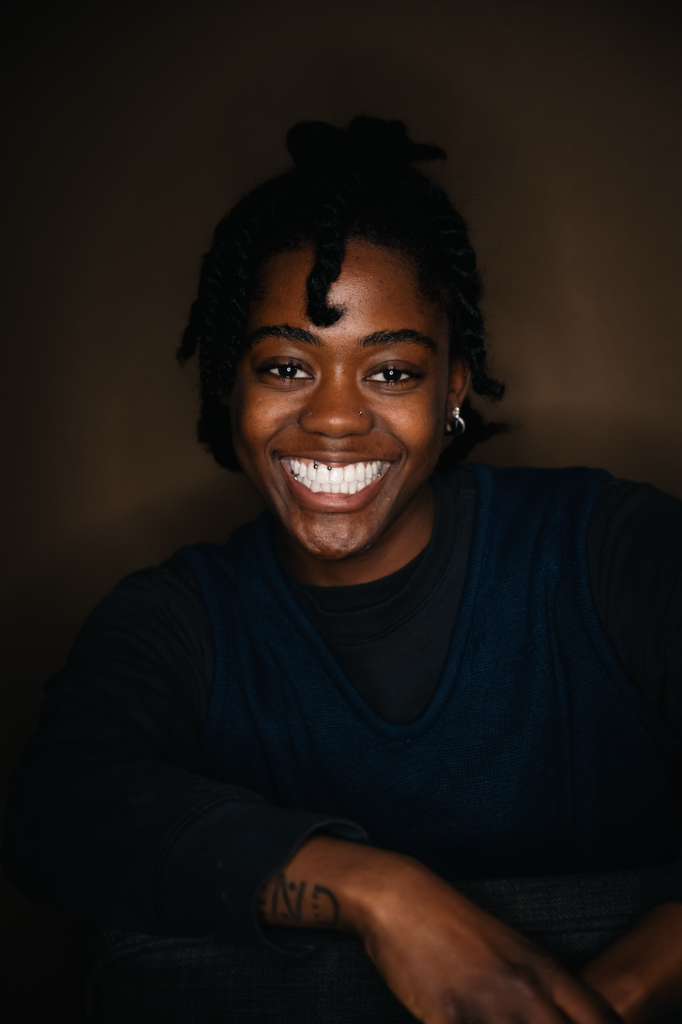
Most students use their student loans to cover the rising costs of textbooks and housing. Kay’te Ingram used hers to cross an Atlantic Ocean that her ancestors were once forced across, all to find a family she never knew she had.
A graduate student at the California Institute of Integral Studies, Kay’te is currently on the ground in Surulere, Lagos, turning her academic study of Anthropology and Social Change into a living, breathing reality. Her project, Sustainable Rootology, is a hybrid of ancestral discovery, robotics-backed security, and social impact that defies the “business theory” found in traditional classrooms.
What is Sustainable Rootology?
Sustainable Rootology is a social enterprise that bridges the gap between the African diaspora and the motherland. It is built on the belief that both Nigerians and Black Americans have been fed false narratives about one another by colonial education systems.
“We see diaspora wars, African Americans against African-born,” Kay’te explains. “Our role is to remind us of the strength we hold together.”
The project operates through several specialized arms:
- The Listening Campaign: A research initiative where scholars (including experts in Biochemistry, Sociology, and Psychology) visit historical sites like Badagry to confront the history of the slave trade and reclaim cultural narratives.
- Access Languages: A project focused on preserving mother tongues like Igbo and Yoruba, while also looking toward global trade by teaching Mandarin.
- Community Accountability: A network that connects poets, artists, scientists, and engineers to collaborate on local problems.
The “Science of Commerce”: Funding via Sacrifice
The logistics of Sustainable Rootology are a masterclass in student grit. The project is not backed by venture capital; it is bootstrapped by Kay’te’s own future.
“I funded this through my student loans that were meant for housing,” Kay’te reveals. “I gave up my apartment; I gave up my car. I gave up everything I had to put my resources into my people across the ocean.”
This is the “Science of Commerce” in its rawest form: Resource Allocation. Kay’te is betting that the social capital she builds in Surulere will yield a higher return for her community than a comfortable apartment in California ever could.
The Technical Edge: Robotics and Security
Sustainable Rootology is unique because it integrates high-tech solutions into social activism. Kay’te’s partner and the project’s Director, Ms. Adebusola “Fola” Adereti, is a robotics expert and CEO of TA-SEA.
For eight years, Fola has worked in the male-dominated field of robotics to build security systems. This technical background is the backbone of the project’s safety initiatives, including:
Purple Power: A feminist group founded by Fola and led by law students. They recently traveled to Enugu to address femicide and child abuse following the tragic Ochanya case.
Safe Houses: The team is currently practicing the logistics of renting and maintaining safe houses for women and children trapped in unsafe environments.
The Badagry Scholars: Overcoming Inherited Fear
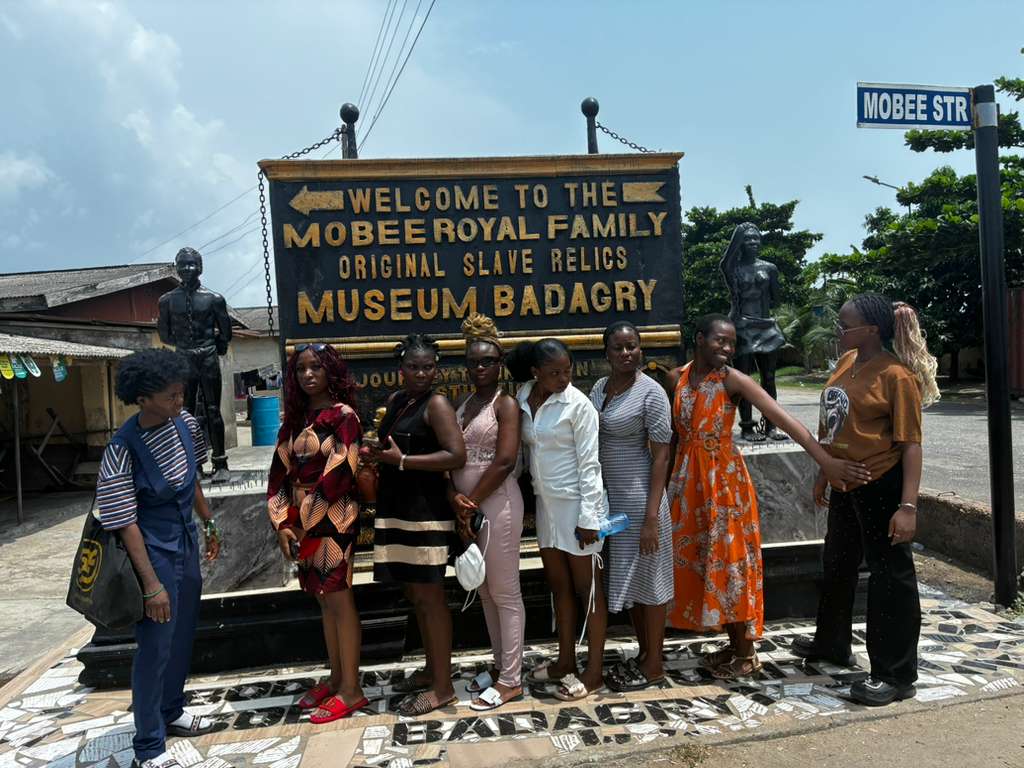
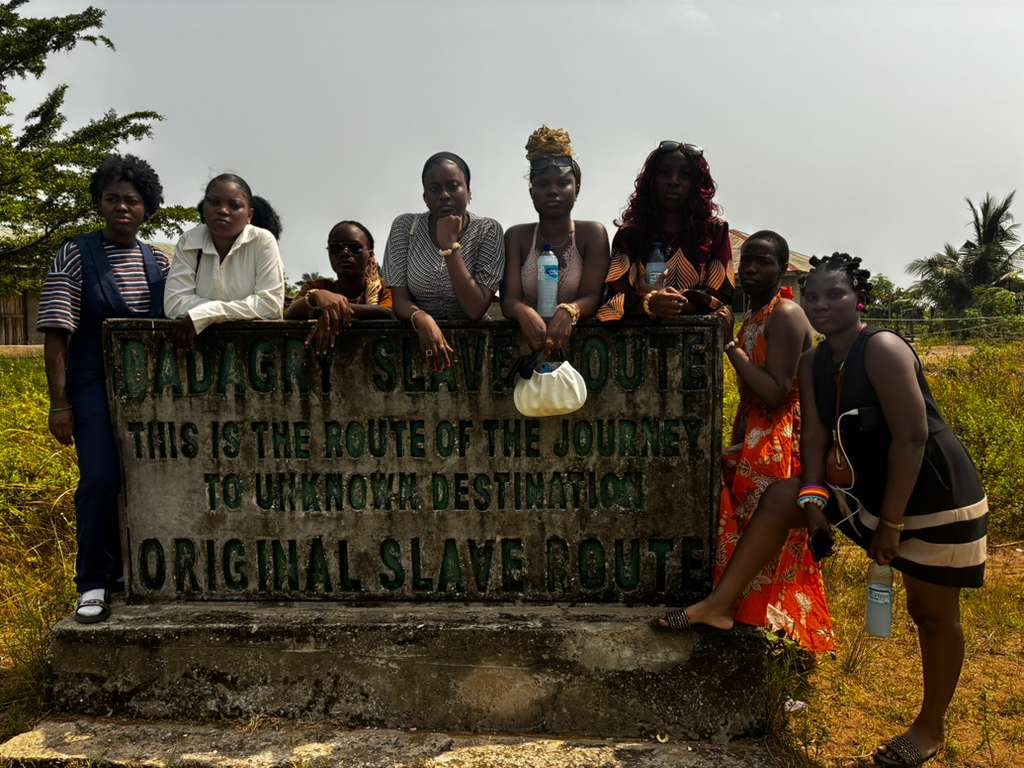
To launch their first pilot, the team organized a group of eight scholars, including Dabby (Medical Student), Nelly (Biochemistry), Pelumi (Sociology), and Zainab (Psychology). They journeyed to Badagry to confront the “Land of No Return.”
The journey was emotional and transformative. “In America, we were taught ‘Black people can not swim,'” Kay’te notes. “It is a lie. Many of the women were afraid of the water and the horses. But we held hands. We crossed the water with reverence and power. We proved that fear is an inheritance we can refuse to accept.
The Lagos Hustle: 2:00 AM Classrooms
Because her program is based in California, Kay’te lives on two different clocks. When Lagos goes to sleep, her school day begins.
“My class time is at 2:30 AM,” she says. “I set five alarms just in case I fall asleep. But my community here wakes me up. They remind me that we all have to succeed together.”
The Burkina Faso Revelation
The impact of Sustainable Rootology is not confined to Nigeria; it is a global movement of remembering. Kay’te’s vision has already taken her to India and South America, but the recent mission to Burkina Faso stands out.
Adetola, a Nigerian citizen and team member, was sent to a conference in Burkina Faso just before her NYSC, her first time traveling outside Nigeria. The gathering brought together leaders and students of all faiths to discuss unity and the reclamation of stolen resources.
“We have been told that Christians and Muslims, or people from different countries, can not coexist,” Kay’te explains. “Adetola’s experience proved that these divides are often just social constructs of oppressive systems. We are stronger when we bring our resources together to transform our circumstances.”
The Vision: A Global Network
While currently in its pilot phase in Surulere, the land where the majority of Kay’te’s ancestors are from, the vision is already expanding across the continent and the globe. Kay’te is connecting with other student founders like Toluwalase Vaughan (Founder of Life in my 20s) to build a support system that stretches from Lagos to Oakland and beyond.
About The Author