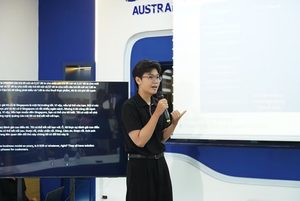

VERA AI by Tong Zeng: Evaluating Startup Pitches Like Investors

Students preparing for business case competitions often receive feedback that is too general to be helpful. Comments like “good presentation” or “nice idea” do not clearly explain what worked and what needs improvement. To solve this problem, Johns Hopkins Carey Business School student Tong Zeng created an artificial intelligence tool called VERA.
How VERA works
VERA, which stands for Venture Evaluation and Reasoning Agent, is designed to evaluate startup pitches the way an experienced venture capitalist would. Instead of simply analyzing text, the AI examines several aspects of a presentation to provide detailed and useful feedback.
One of VERA’s main strengths is its multi-modal ability. The system can analyze pitch presentations in different formats, including slides, PDFs, and audio recordings of the presenter. It also uses a structured judging rubric to guide its evaluation.
VERA uses advanced large language model (LLM) reasoning and the speech-to-text system OpenAI Whisper to accurately transcribe and analyze spoken presentations. After reviewing the materials, the system produces a detailed scorecard, a radar-chart visualization, and written feedback explaining why each score was given. This helps founders and students understand exactly what they did well and what they should improve.
For students and startup founders, this type of feedback can be extremely valuable. Instead of receiving vague praise, they get specific, actionable insights about their business logic, presentation structure, visual materials, and delivery style. VERA can evaluate elements such as the clarity of speech, pacing, persuasion, and the strength of the business idea.
Zeng Combining Tech and Product Thinking
Building the system required both technical and product-design thinking. Zeng combined several concepts taught in the Information Systems and Artificial Intelligence program, including machine learning, generative AI, and responsible AI practices. The tool was designed to connect its evaluations directly to a judging rubric, making its feedback transparent and explainable.
Developing VERA was not easy. The system needed to handle large files like 10MB PDFs and audio recordings lasting up to six minutes. To make this possible, Zeng implemented engineering solutions such as image compression and performance optimization.
One of the most exciting moments for Zeng was seeing the AI process large inputs smoothly and generate a complete evaluation report. He also enjoyed fine-tuning the AI model so that it would respond like a professional investor rather than giving generic feedback.
About The Author