

Rishab Chhetri: Building an AI that Answers Career Questions
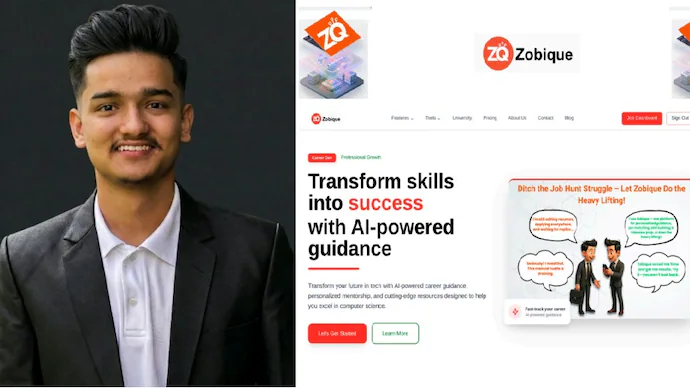
Some startups begin with a eureka moment. Rishab Chhetri’s startup began with a pattern he could not ignore.
As a first-year BTech student and freelance frontend developer, Rishab had quietly become his classmates’ go-to career advisor. They asked him questions like which programming language to learn, what career path to follow, whether to go into AI constantly. He answered them willingly, until he noticed something that changed everything. Every student he guided had different learning styles, different motivations, and different paces. As a result, Generic advice could only take them so far, and he could not personally reach everyone who needed help.
Rishab decided to build a software version of himself
Consequently, that decision became Zobique, an AI career intelligence platform that reads a student’s profile, identifies skill gaps, builds a personalized learning roadmap, and points them toward real opportunities. The first version was a simple chatbot that paired a student’s resume with a short behavioural assessment. That version got things wrong often. However, every mistake generated feedback, and every round of feedback made the product sharper.
Building is not without Challenges
The early days were anything but comfortable. Rishab and his co-founders Mohit Kholiya and Vansh Attri who joined after a pre-seed grant from the Manav Rachna Innovation and Incubation Foundation; spent nights writing code, rebuilding failed features, and talking to students while managing exam schedules and dwindling resources. In fact, Professors warned them that entrepreneurship rarely ended well for students. Friends and family questioned why they were not simply preparing for placements.
The doubt was constant but there was also evidence that what they were building actually worked. It was enough to see students walk away with real clarity instead of more confusion.
What Project Zobique has taught Rishab
The biggest lesson Rishab took from the journey was not technical. He learned that startups are not only built by writing more code. They are also built by understanding people. Almost every student he spoke to shared the same core fears: picking the wrong path, wasting time, falling behind. Yet each person needed a completely different approach to work through those fears. That insight became the foundation of everything Zobique was built on.
One moment captures it best. A junior who had been struggling with React.js for a month was given access to Zobique. Two months later, he came back with a single sentence: “Bhaiya, this worked.” That, Rishab says, meant more than any metric on a dashboard.
Today, Zobique has grown far beyond a college project. The platform now integrates with the Government of India’s National Career Service portal, putting a tool that started between college lectures into the hands of millions of students nationwide.
What this means for student entrepreneurs
His advice to aspiring student entrepreneurs is simple: stop chasing billion-dollar ideas. Pay attention to the problems people keep bringing to you. The biggest opportunities are often hiding inside the questions your friends will not stop asking.
About The Author